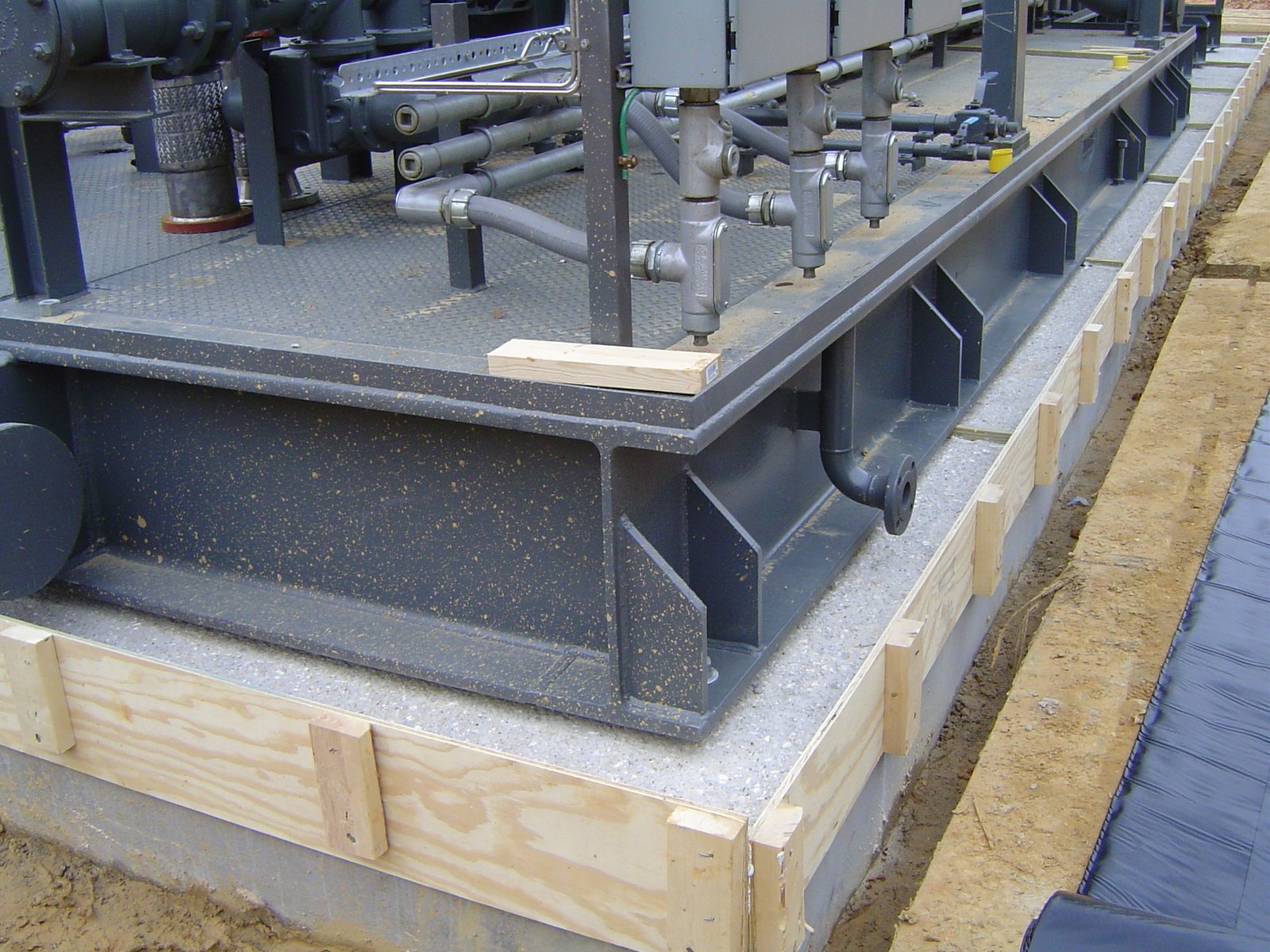
Every rotating machine wants its own foundation. A compressor shaking itself loose from a thin slab, a pump skid that walks off its bolts, a generator that hums into the next room: all of them start with a pad that was sized to the weight and forgot the vibration. An equipment foundation is mass, stiffness and the right bolts in the right place.
We build pads and foundations for compressors, pumps, generators, tanks, exchangers, process skids and heavy machine tools at heavy industrial plants, fab shops and oilfield facilities in Casper and Natrona County. Some are replacement pads inside a running unit during a shutdown. Others are new foundations for equipment arriving on a truck next month. In both cases the work is tight on dates, tight on tolerances and close to things that can hurt people.
The vendor's drawing is the starting point. Soil, frost, groundwater and access make it real.
What the vendor drawing does not tell you
Vendor drawings give the footprint, the weight, the bolt layout and often a minimum mass. They do not give the soil, the frost depth, the groundwater, the spacing to the next unit or the crane access. We check each against the site, and we ask the engineer when the answer changes the design. A foundation that is right on paper but cannot be built because the crane cannot reach it is a failed foundation.
Dynamic loads change everything. A reciprocating compressor needs a block foundation with mass and isolation from adjacent slabs. A centrifugal pump can sit on a lighter pad. Tanks need ring walls or slabs and settlement monitoring. The structural engineer sets the design. We confirm that the forms, rebar, embeds and pour sequence match what the engineer drew, and we flag conflicts before the concrete is ordered.
Power, process and the equipment around Casper
Large rotating equipment is a way of life here. A large coal-fired generating station stands at Glenrock along I-25 east of Casper, and the dam powerplant at Alcova on the North Platte has two 18 MW Francis turbines, 36 MW installed, producing roughly 92 million kWh a year. Equipment of that size sits on foundations with serious mass, and the same principles scale down to the pumps and compressors in refineries and oilfield facilities.
On the site of the former refinery now called Platte River Commons, the ground carries a long history. The refinery ran from 1895 to 1991, a remedy agreement was signed in 2002, and the site is still recovering from contamination. Any foundation work there starts with a soil management plan: what can be dug, where spoil goes and what is tested. Owners of power and utility sites face a similar discipline whenever the ground has an industrial past.
Forms, rebar, embeds and grout
We excavate, shore where required and prepare the subgrade. Footings are poured over compacted structural fill or on native soil proven by test. Reinforcement is tied to the engineer's drawing, often heavy and tight. Embeds, sleeves, anchor bolts and rods are set to a template or a frame and checked by survey before the pour, because a one-half inch error in an anchor bolt is a day of chipping and field fixes.
After the concrete cures, the equipment is set on shims or leveling nuts and grouted. Epoxy or cementitious grout fills the gap between baseplate and foundation, and it transfers load. We control grout temperature and mixing, because poor grout is the second most common cause of vibration trouble. Our trade partners can also place curbs, sumps, containment and trench drains with the pad, and tie the pad into the surrounding industrial floor slab so spills stay on the pad.
Trade partners we sequence closely
We schedule and supervise excavation, forming, reinforcing, embed setting, concrete placement and finishing on pads and foundations. That keeps the sequence tight, because the anchor bolts are set and the concrete is poured around them in one planned sequence. We can also coordinate deep foundations when soils call for piles or piers beneath a heavy pad.
For work next to an operating unit, we plan for a small, experienced crew rather than a large one. We pre-build rebar cages and forms outside the fence where possible, and set them in the permitted window. Work scheduled around the permit to work leaves little room for slow hands.
Hot units, hot work and tight spaces
Excavating near running equipment brings risk. We locate buried lines, pothole by hand, shore the trench and watch for gas. Confined space entry, hot work and lock-out and tag-out are handled under the owner's permits. A signed permit to work names the hazards and the isolation points before anyone on our team touches the area.
We stage materials and equipment away from process lines, rig loads with signal people, and keep the crane radius clear. Every worker attends the site orientation. If conditions change, we stop and ask. A paused foundation is cheaper than an incident.
Pour dates and cure time
Foundations sit on the critical path. The equipment cannot be set until the concrete reaches the required strength, and in winter that takes longer. We plan the pour so cure time ends before the equipment shows up, with a margin. Vendors slip, so we also plan to protect an open foundation if the delivery moves.
Cold weather placement uses heated enclosures, insulated forms and temperature logging. Mass pours need cooling or controlled placement so the core does not crack. We coordinate the pour with the batch plant, the pump truck and the inspector, and we hold a pre-pour meeting with everyone who touches the work. For a steel-heavy unit, we align the pad schedule with structural steel erection so the pad is ready when the crane is.
Send the vendor drawing and the shutdown dates
Share the equipment data, the soil report and the window you have. We will review constructability, price the work and plan the pour and cure around your schedule.
Common Questions
Can you replace a pad during a shutdown?
Yes, if the demolition, forming, pour and cure fit inside the window. Fast-setting mixes and heated enclosures help. We plan the sequence in detail ahead of time and prebuild what we can.
Who designs the foundation?
A structural engineer, using the vendor's data and the geotechnical report. We build to the drawings and review constructability with the engineer before the pour.
What about contaminated soil?
We follow the owner's soil management plan: sampling, segregation, disposal and worker protection. On sites with an industrial history, expect testing and plan time for results.
How do you control anchor bolt position?
We use templates or frames and survey the bolts before and after the pour. Any deviation is corrected before the concrete sets.
What is the grout for?
It fills the space between the baseplate and the foundation, carrying load and damping vibration. Poor grout leads to loose equipment and misalignment.