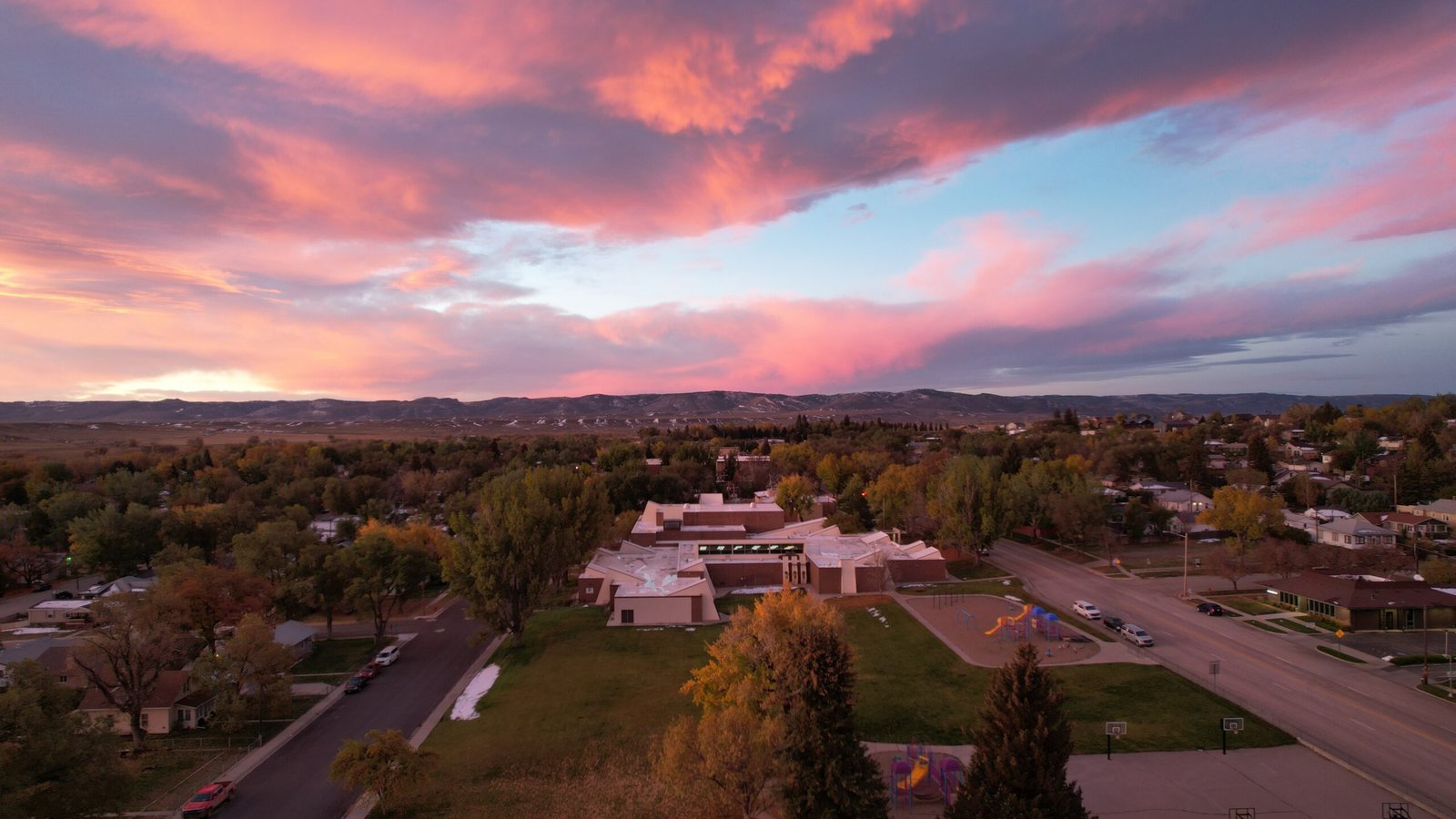
Plant outages decide the calendar in Glenrock. The coal-fired Dave Johnston Power Plant is at Glenrock, and any contractor who builds near a generating station learns that the outage window is fixed and the laydown yard is never big enough. We build foundations, access roads, laydown pads and shop buildings for owners who work around that kind of schedule.
Our teams attend your safety orientation, work under your permit to work and keep tools, fuel and materials inside the boundary you set. We treat energized equipment, buried cable and overhead lines as live until your operator says otherwise, and we do not excavate near any of it without a locate and a hand-dug check.
Glenrock sits at about 5,020 feet on the interstate corridor between Douglas and Casper.
Power, utility and industrial owners
The utilities and power sector drives much of the work we plan in Glenrock: equipment pads, switchyard grading, cable trenches, access roads and temporary yards for contractors. Each one has a different tolerance. A transformer pad is a level, reinforced slab with oil containment; a laydown yard is a drained, stable surface; a trench is a safety problem first, and a drawing problem second.
Outside the plant fence, smaller industrial owners need shop buildings, equipment storage and fabrication space close to the interstate. We build those as pre-engineered metal buildings on engineered slabs, and we put the shop and the yard on one plan. Converse County covers 4,265 square miles, so a yard in Glenrock suits operators whose crews travel.
Building around outage windows
Outage dates are set months ahead, and contractors converge on them. In the weeks before, we try to finish anything that needs curing, inspection or utility connection, so the pad is ready when the equipment arrives. During the outage we either stay out or work in a lane the outage lead assigns.
Deliveries are the pinch point. Rebar, concrete and steel need gate time, and the gate is crowded. We coordinate delivery windows, use staging off site where needed and keep trucks moving. If a pour cannot be done during an outage week, we place it before and let it cure, or after and accept the later date.
We also watch for the quiet weeks. When the plant is between outages, gate times loosen and laydown opens up. That is the time for heavy excavation and long pours. We ask the owner's planner which weeks are open and schedule equipment against them.
Where Glenrock sits on the route
Interstate 25 runs concurrent with US 87 through Glenrock, I-25 Business serves the business district, US 26 runs east-west through the center and Wyoming 95 runs north toward Rolling Hills. That is a lot of road for a town with 2,420 residents in the 2020 census, and it means trucks reach a site from several directions.
For us that translates into simple logistics. Crushed rock, ready-mix and steel arrive by highway. Our teams can reach the town from Casper or Douglas in the same day. Owners who need a quick response get one, because the team is not coming from another region.
What we manage closely
We closely manage excavation, grading, forming, rebar, concrete and metal building erection. For a power-side owner, the key pieces are electrical duct bank and underground work, concrete encasement, manholes and the pads that carry heavy equipment. We set conduit to the drawing, spacers at the right interval and pour the encasement in one controlled placement.
We also build deep foundations and piers when soil demands them. Crews follow the owner's procedures for lockout, grounding and excavation near energized lines, and a safety lead is on site whenever we are working near live equipment.
Concrete placement near existing equipment has its own risks. Pumps, trucks and vibrators crowd a small footprint, so we set a traffic plan with flaggers, protect existing foundations and cable from washout, and keep slurry out of drains. We also clean wheels at the gate so a plant road does not become a mud track.
Excavation near live lines
Most serious injuries in site work involve digging, lifting or energized equipment. We treat all three with respect. Before any dig we call for locates, review the owner's drawings, pothole by hand and mark the result. If a line is not where the drawing says, we stop and tell the owner.
Cranes and booms near overhead lines get a spotter, a measured clearance and a written lift plan. Trenches get shoring or sloping to the competent person's call. We hold a stop-work rule that anyone on the crew can use, and we expect the rule to be used.
What drives the cost
Outage-driven work is rarely priced like ordinary work. Overtime, night shifts, shared laydown and tight gate access all add cost. We separate those items so you can see what the schedule costs and decide whether to move the date.
Soil, haul and utility conflicts add more. We give a range after a site walk and a fixed price after the geotechnical report and survey are in hand.
Owners sometimes ask us to hold a price for a year. We can, if the scope and the quantities are fixed. We will not hold a price against a vague scope, because someone has to carry the risk and it ends up being you.
Planning work around a Glenrock outage?
Give us the window, the scope and the access rules. We will tell you what must happen first. See also our work in the airport business park and the metals and heavy industry jobs we plan.
Common Questions
Can you work during a plant outage?
Yes, if the owner approves the scope and the lane. We attend the outage orientation, work under the outage permit to work and coordinate lifts and deliveries with the outage lead. For some jobs it is safer to finish before the outage, and we will say so.
How do you protect buried utilities?
We obtain locates, review owner drawings, pothole by hand where lines are expected and mark everything on the ground. Equipment stays outside the marked zone until the line is exposed and verified. If something does not match, we stop.
What do you need to price an equipment pad?
The equipment weight and footprint, anchor bolt layout, vibration data if any, soil report and the required tolerances. With those we can detail the reinforcing, the base and the grout, and give a firm number.
Can you work from Glenrock for jobs in Douglas or Casper?
Yes. The three towns lie along the same interstate, so we plan crew moves and equipment hauls as one route. If you have work at more than one site, tell us and we will combine mobilizations.
How long does a duct bank take?
It depends on length, depth, congestion and the number of ways. A short straight run can be finished in days; a long run with crossings and manholes takes weeks. We give a schedule with the trench open length limited, so the open ground is safe.