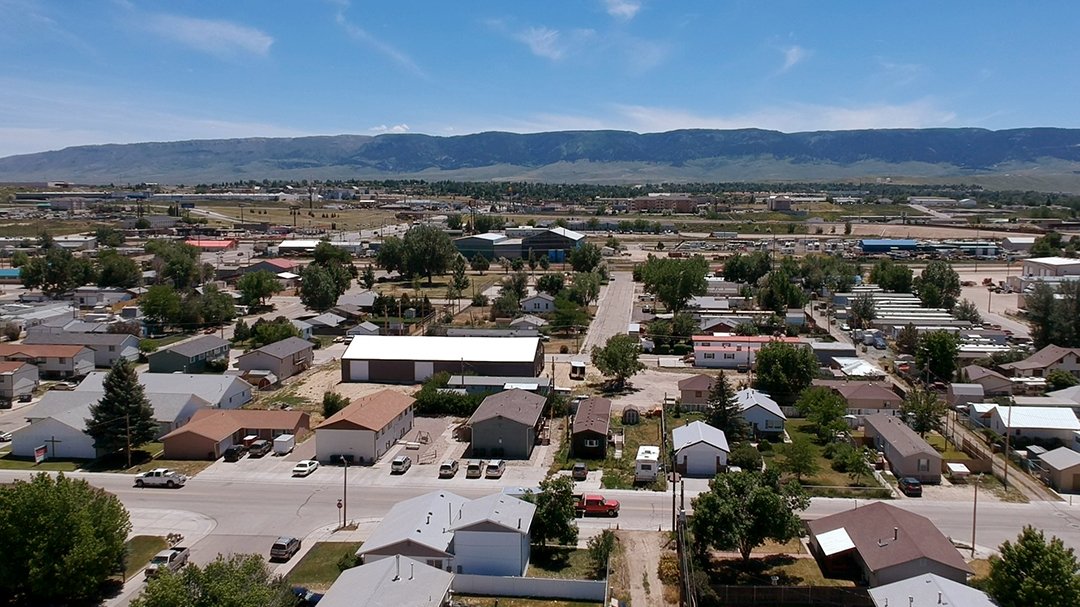
Evansville work starts with a hard question: what is under the ground? The town is home to the surviving Casper-area refinery, and a Superfund site along US Highway 20 in Evansville involves groundwater contamination believed to trace to former industrial operations. Any excavation here is planned before the first bucket goes in.
We build for owners and contractors who work in that setting: equipment foundations, laydown yards, shop buildings and access roads next to an active fence line. We attend your safety orientation, take our place on your permit to work, and keep our teams out of any area the permit does not name.
Evansville sits at 5,125 feet along US 20, east of Casper, so we can stage crews, materials and rented equipment from the city while the job runs.
Working beside an operating refinery
A refinery boundary changes the rules. Vehicle routes are controlled, ignition sources are limited, and a gate pass can take longer than the work behind it. We plan for that: our people are oriented and badged before the mobilization date, tools are inventoried in and out, and nothing with a spark or a flame moves inside the line without a hot work permit signed for that day.
We also plan for the shutdown. During a turnaround the site fills with contractors, cranes and scaffold, and ground-level space is gone. If we have work that must finish before the turnaround, we date it ahead of the contractor surge. If our scope needs to run inside it, we coordinate lanes, laydown and lifts with the turnaround lead, and we use the phased construction in occupied sites practices that keep a live unit separate from a construction zone.
What the town gives an industrial owner
Evansville is part of the Casper metropolitan statistical area and grew from 2,544 residents in 2010 to 2,746 in 2020. That small town count sits next to a heavy industrial base. US 20, 26 and 87 leave I-25 at Beverly Street and run east along Yellowstone Highway through Evansville, and Wyoming 258 on Curtis Street gives a direct line back to the interstate.
That access makes the town useful for fabricators, hauling companies and contractors who support the refinery district to the east and the industrial operations around it. The east Casper refinery area shares the same corridor, so a company with work on both sides of the line can run them from one mobilization.
What we manage closely
We closely manage the work that sets quality and safety: excavation, grading, forming, reinforcing, concrete placement and finishing, and the erection of metal buildings. That includes equipment pads and foundations sized to the machine and its vibration, and industrial concrete floors for shop and storage buildings.
Close management matters at a refinery gate. One crew badge list, one safety program, one set of rules. We bring electrical, mechanical and specialty trades under the same safety plan, and we hold their people to the same orientation. It keeps the number of strangers on your site low.
Groundwater, soil and the cost of a surprise
Because of the groundwater issue on US 20, we treat every dig in Evansville as a soil and water question first. Before we price a basement, a sump, a deep footing or a utility trench, we ask what is known about the parcel: prior studies, monitoring wells, deed notes. If the information is thin, we recommend a Phase I review and borings, and we write the contingency into the price instead of hiding it.
If the work encounters stained soil or odor, we stop, notify you and wait for direction. We do not move suspect soil off the property without your environmental consultant's plan. We also keep dewatering discharge on site until the rules for it are confirmed, and we keep that cost visible so the budget has an honest line.
Fitting work between turnarounds
Refinery schedules run on turnarounds and shutdowns, and those dates sit months ahead. We ask for them on day one. Concrete that must cure before equipment sets needs to be placed well before the outage, and anything delivered late jams the laydown yard during the busiest weeks of the year.
Cold weather matters here too. Evansville sits at 5,125 feet, and winter pours need protection. We plan the foundations and slabs for the warm window and the enclosed work for winter, so the crew keeps working instead of waiting for a thaw.
Permits and design values
Natrona County and the town have their own offices, and Wyoming does not have a single statewide building code: cities and counties adopt and enforce locally, so requirements vary by jurisdiction. We confirm with the Evansville office what applies to your parcel, and we ask for the snow, wind and frost values in writing.
For work that touches an industrial boundary, we also check the owner's own standards. Many plants hold specs for concrete, coatings, rebar cover and welding that go beyond the local code. Where the two differ we follow the stricter one, and we put the difference on the submittal log.
Need a refinery-side site priced the safe way?
Tell us the parcel, the permit to work rules and the next shutdown date. We will send back the questions we need answered before pricing. You can also read how we handle work in neighboring Mills or the metals and heavy industry work we plan.
Common Questions
Do you work inside refinery fence lines?
We work under the owner's permit to work and site rules wherever the owner allows. That means badging, safety orientation, hot work permits and lockout coordination before we start. If your site has separate contractor requirements, send them early so we can plan crew selection and staging.
What is the Superfund site in Evansville and does it affect me?
It is a groundwater contamination site along US Highway 20 that is believed to come from former industrial operations. Whether it touches your parcel depends on location. We recommend checking records and, if needed, a Phase I review before design, and we plan any excavation and dewatering with that in mind.
Can you build a slab or equipment pad that will not move?
Yes. We size the pad to the equipment weight and vibration, set the base on compacted structural fill or piers where the soil requires it, and detail joints and anchor bolts to the equipment drawings. A pad that must stay level for years starts with the geotechnical report.
How do you handle work during a turnaround?
We either finish before the outage or schedule inside it with the turnaround lead. Crews attend the extra turnaround orientation, deliveries follow the gate plan, and lifts go through the same review as the outage crews. We do not squeeze work into a congested plant for the sake of a date.
Is the work in Evansville priced differently from Casper?
The building costs are similar, but the risk items differ. Groundwater, access control and owner site rules add time and sometimes cost. We price those items separately so you can see what they add.