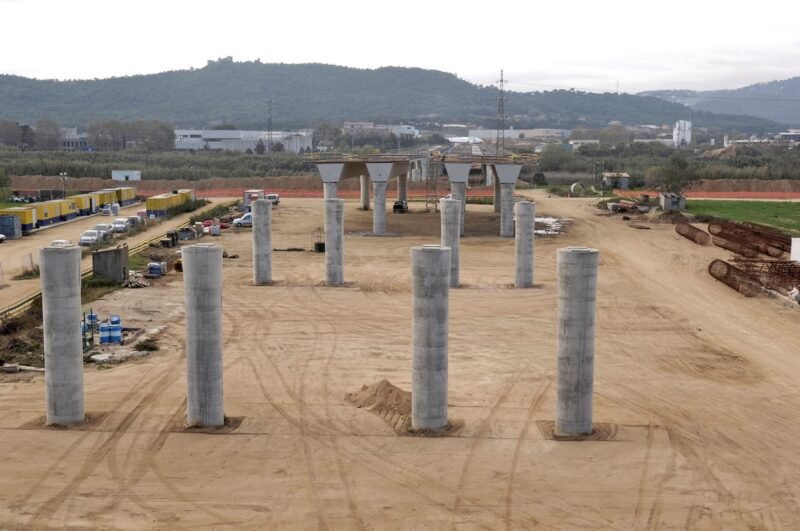
Auger rigs do not care about your shutdown date, and neither does groundwater. A drilled pier is a hole, a steel cage and a column of concrete, and each of those three steps has its own way of going wrong. Hole walls cave, cages float, concrete bleeds into voids. Getting a good pier is a matter of following a procedure in the same order every time.
We drill and pour piers for building columns, crane runways, pipe racks, tanks, signs, light poles and equipment that needs a deep, stiff foundation. Typical diameters run from a couple of feet to several feet, with depths set by the soil report and the load. The work is common in and around Casper, from the river flats to the benches and the oil field country east and north.
For help choosing between pier types and other deep systems, see our page on deep foundations and piers. This one is about drilling and pouring them correctly.
From layout to concrete
The sequence is the same every time. A surveyor sets each pier center, we check utility locations, and the rig sets up on a prepared pad. We drill to the design depth, clean the bottom, and the inspector checks the hole for diameter, plumbness, depth and bottom condition. The rebar cage, built to the drawing with spacers, is lowered in and held in position. Concrete goes in through a tremie or a drop chute, depending on whether water is present.
Anchor bolts or embedded plates are set to a template at the top of the pier, then checked again after the pour. We record each pier: depth, soil description, water level, concrete volume and any variations. If a column base is a half inch off, steel erection pays for it, so we hold the template tolerances tight. Cutoff, curing and backfill follow, and exposed tops are protected from the weather.
Specialty partners and equipment on one team
We run drilled pier work through our specialty trade partners: layout, drilling, cage placement, anchor bolt setting and concrete. That keeps accountability in one place. Cage fabrication can be on or off site, and long cages are lifted with a crane and set with a spreader to avoid bending.
Where the job needs temporary casing, slurry, rock augers or specialty tooling, we bring in that capability and keep the schedule under our control. For jobs connected to a larger building, our work links directly to structural steel erection, so the foundation tolerances and the steel erector's tolerances agree before the first column is picked.
River, benches and the oil field
The North Platte runs through Casper, and ground near it carries groundwater that can collapse an open hole. In Casper, river-bottom sites often need casing or slurry to hold the hole open, and concrete placed through a tremie so it displaces water instead of mixing with it. Away from the river, bench ground drills dry, which is faster and gives a better view of the soil.
Large structures have long been part of the area. The Alcova Dam, a 265 foot high Bureau of Reclamation structure finished on May 8, 1938, shows what this country asks of foundations. In the oil field, Salt Creek operators drill through ground with old wells nearby. In 2016, CO2 leaking from an abandoned well at the field led to the temporary closure of a school, which is a reminder that drilling near old wells needs gas monitoring and clear maps. Tell us what you know about abandoned wells, and we will plan for it.
Rigs, gas and open holes
An open hole is a fall hazard and a cave-in hazard. We cover or barricade every hole at the end of each shift, keep a clear zone around the rig, and use spotters for swing and travel. Drilled spoil is stacked away from the edge, and nobody enters a hole without a permit. Entry for inspection uses a cage, a gas monitor and a rescue plan.
Underground lines and overhead lines are locates and measurements, not guesses. Near the oil field and refineries, we ask about hydrocarbons and gas in the soil and monitor air in the work area. We follow the owner's permit to work and the site orientation, and any change in conditions stops the rig until the engineer approves a plan.
Production rates and weather
A rig can often drill and pour several piers a day in good soil, and far fewer where casing, rock or water is involved. Cages must be ready when the rig is, and the concrete plant must be ready when the cage is. We schedule the concrete delivery to match the pier, because concrete that waits in a truck loses workability.
Winter changes the plan. Frozen topsoil slows drilling, and concrete needs heat and blankets. We try to drill and pour piers before the building schedule asks for steel, then cap and protect them. Frost can heave unprotected piers, so we place the tops and grade beams to the frost depth and avoid leaving open excavations around them.
Inspection, testing and records
Pier work generally needs special inspection. The engineer or the testing agency watches the drilling, checks the bottom, approves the cage and witnesses the concrete. Slump, temperature, air content and cylinders are taken. Integrity testing, such as sonic testing, is available for important shafts. We keep the records and hand them over with the closeout package.
The City of Casper requires plan review for structural calculations and engineering reports on commercial permits, and an issued permit is good for 180 days. For a pier-supported building, we schedule the foundation inspections within that window and plan for the permit status as part of the critical path.
Tolerances, loads and neighbors
Tight tolerances matter. A pier out of plumb, off center or short of depth can force a redesign of the cap or the column base. We set control points, check each hole, and correct early. If a pier is out, the engineer decides whether to accept, repair or add another. For heavy industry owners, a missed tolerance becomes a delayed lift.
Neighbors affect the plan too. Spoil and mud tracks need control, noise limits may apply, and a running plant next door may limit vibration. We build haul and working pads, wash wheels at the exit and haul spoil in covered trucks. Piers near an existing slab or equipment foundation may need underpinning or monitoring.
Send the boring logs and the column loads
Share the geotechnical report, the foundation plan and the steel schedule. We will price the piers, choose the drilling method and set a pour sequence.
Common Questions
How deep do piers go in Casper?
Depth comes from the soil report and the load. Frost depth sets the minimum, and the bearing layer sets the rest. Piers may be shallow on rock-bearing benches and deep in river alluvium.
What if we hit groundwater?
We use casing or slurry to hold the hole open and place concrete through a tremie to displace the water. The engineer approves the method. Groundwater adds time and cost, so we report it as soon as it appears.
Can you drill near old wells or pipelines?
Yes, with maps, locates, gas monitoring and the owner's approval. We stop if we see signs of gas or an unexpected pipe, and we do not resume until the plan is revised.
How do you hold anchor bolts in place?
With a steel template set to survey control and checked before and after the pour. A tight tolerance saves the steel erector from field fixes.
How soon can steel start after the piers?
After the concrete reaches the specified strength and the engineer releases the foundation. Cold weather can slow strength gain, so plan on cylinder breaks, not a calendar.