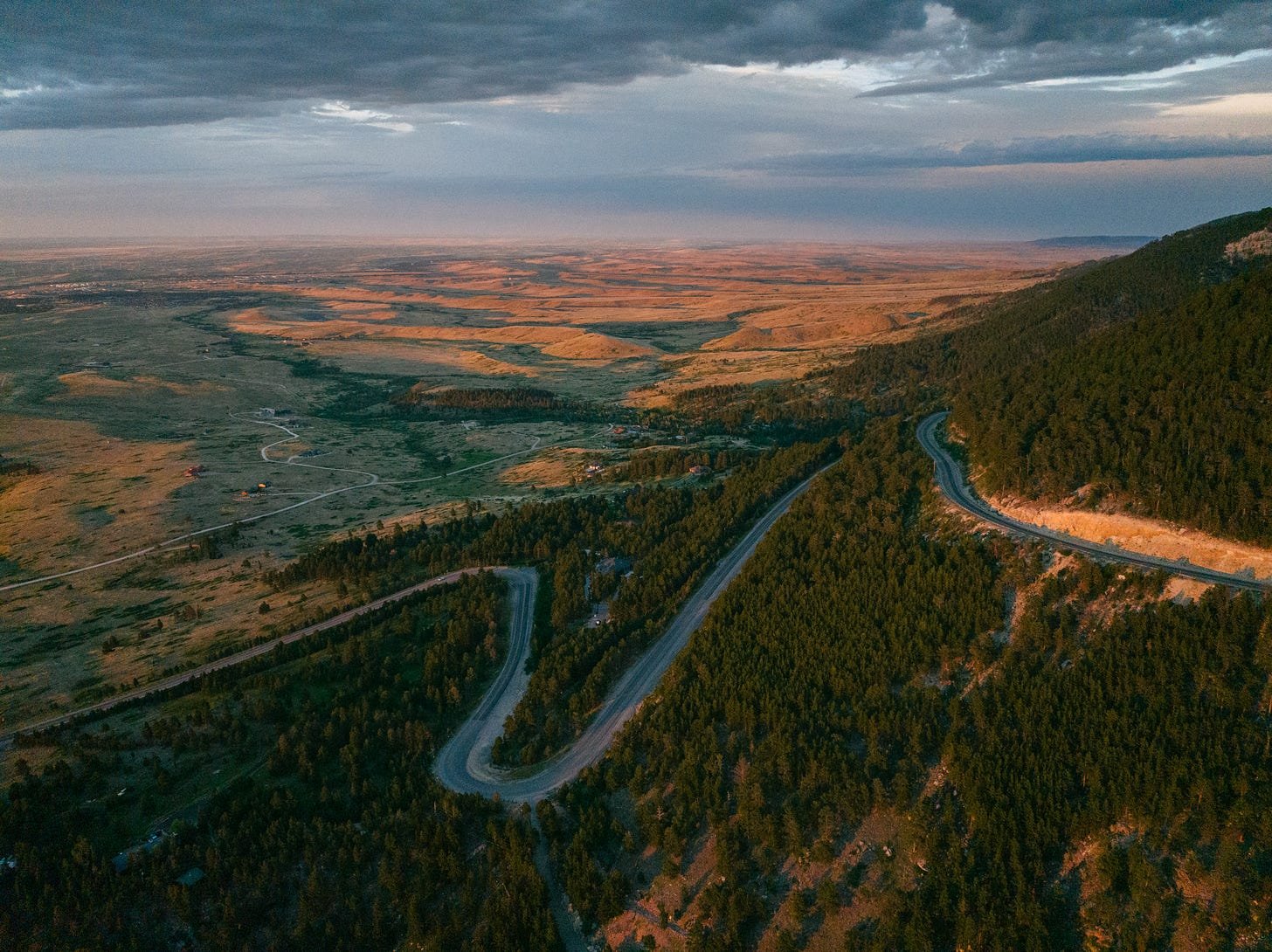
Grade is the first thing we measure on Casper Mountain, before the footprint and before the budget. The mountain rises to 8,130 feet, roughly 3,000 feet above Casper, at the north end of the Laramie Mountains. Building on it means building on a slope, in weather that is harsher than the valley, and on rock that geologists have mapped with an anticline and a fault line on the north side.
We build the industrial side of that terrain: communications and power equipment pads, access roads, retaining walls, utility trenches and small service buildings. Wyoming Highway 251 climbs the mountain, which holds the Hogadon Ski Area and trail recreation, so the road already carries tourists, plows and service vehicles. Our haul plans fit around them.
Many of Casper's TV and FM transmitters sit on towers at Tower Hill on the mountain. Sites like that need level pads, stable footings, clean power and a road that opens in January. Our project teams work under a permit to work, complete a safety orientation before first access, and stop work when wind, ice or fog changes the risk.
Slope, rock and weather
A mountain site shows its problems early. Cut and fill is steep, so we plan benching, drainage and retaining structures with the engineer. Water has to be led away from pads and roads on every slope. If it is not, it undermines the base in the first thaw. Our approach to stormwater and drainage is to start with where the water goes and build the pad second.
Geology matters. A fault line and an anticline mean the rock is not uniform, so we ask for a geotechnical report before design. Where bedrock sits shallow, we expect rock excavation, hammering or blasting by a licensed specialist. Where soil is thick, we expect settlement and plan the footings. Never assume the lower slope tells you what the upper slope holds.
Design loads, frost and review
Design loads vary widely across Wyoming and are set locally. The City of Casper lists climate zone 6B, a 3 foot frost line to top of footing and severe weathering, and it directs snow load to the current code. A site high on the mountain is likely to see more wind and snow than the city, so we ask the engineer to confirm criteria for the specific parcel with the authority that has jurisdiction.
Permits depend on land ownership, use and location. City, county, state and federal rules may all be in play for access, utilities or tower structures. We do not assume. A tower or communications structure may add its own review. We prepare the packet, track the review and hold the start date until approvals are in hand. Casper's commercial permit practice, for reference, calls for engineered building and site drawings and gives an issued permit 180 days.
Our team and trade partners
We schedule and supervise clearing, rough grading, trenching, forming, rebar and concrete. For a mountain job, that matters because there is little margin to wait on the schedule in a short season. Equipment operators run excavators, dozers and compaction equipment on grade, and they keep working surfaces safe with benches and berms.
When a site needs piers or footings in hard ground, we coordinate with specialists for deep foundations and piers and manage them under the same permit to work. For pads that carry transmission or power gear, we build with embedded conduit and grounding in place before the pour so installation crews do not cut a new slab.
What a mountain site adds to the price
Slope adds cost through retaining walls, longer haul distances, slower equipment and extra drainage. Weather adds standby days. Narrow roads limit truck size, so concrete and steel may arrive in smaller loads. Seasonal limits mean a job may stop for months, then restart with a new mobilization. We price the restart, because pretending it will not happen only moves the cost to a change order.
We show owners a plain line-by-line estimate: site, access, structure, utilities. If a design change can cut the slope work, we say so. Often a move of fifty feet saves a retaining wall. A walk with the design team before drawings are final is the cheapest money you will spend, and it is a walk we are glad to make.
Build the road first, then the pad
On a mountain, access is the project. We build or improve the heavy-haul access road first, with the right base, crown and ditches. Then we stage equipment at the site and start the pad. Trucks and equipment that cannot reach the site cannot build it. We check turning radii for the longest load, grade for loaded brakes on the way down, and pull-offs where trucks can wait for a clear road. A safe descent matters as much as a safe climb.
We keep winter in view. A road that is not plowed, graded or sanded cannot serve the equipment it was built for. We discuss maintenance with the owner, and where the site will see service in winter we design for plow clearance and snow storage. These ideas apply across the metro, from Casper to the trailhead, and for utility and power infrastructure they are standard.
Walk the slope with us
Send us the parcel, the equipment and the season you need to finish. We will walk the ground with your engineer and return a plan that starts with the road. For work on the valley floor, see our Wyoming Boulevard coverage.
Common Questions
How steep is too steep for an industrial pad?
There is no single limit. Pads for transmitters and power gear can be built on slopes with benching, retaining structures and drainage, but cost rises quickly. We start with the geotechnical report and the equipment footprint, then find the flattest, best-drained spot that still meets access needs.
What does the geology mean for my foundations?
The mountain has an anticline and a fault line on its north side, so subsurface conditions can change within short distances. A geotechnical investigation before design is essential. It tells us whether to expect rock, thick soil or mixed conditions.
Can you work in winter at elevation?
Some tasks, yes. Earthwork and concrete get harder as temperatures drop, and snow can close the road. We schedule critical pours for warm windows and use heat and protection when we must. The mountain climbs about 3,000 feet above the city, so conditions can differ from town.
Who permits a tower or communications pad?
It depends on the land owner and the structure. City, county, state or federal agencies may be involved. We map the approvals early so the schedule reflects real review times.
How do you manage road access during construction?
We build or improve the road first, schedule heavy deliveries away from peak recreation traffic and use flaggers where needed. Highway 251 climbs the mountain, so we coordinate with its users and agencies.