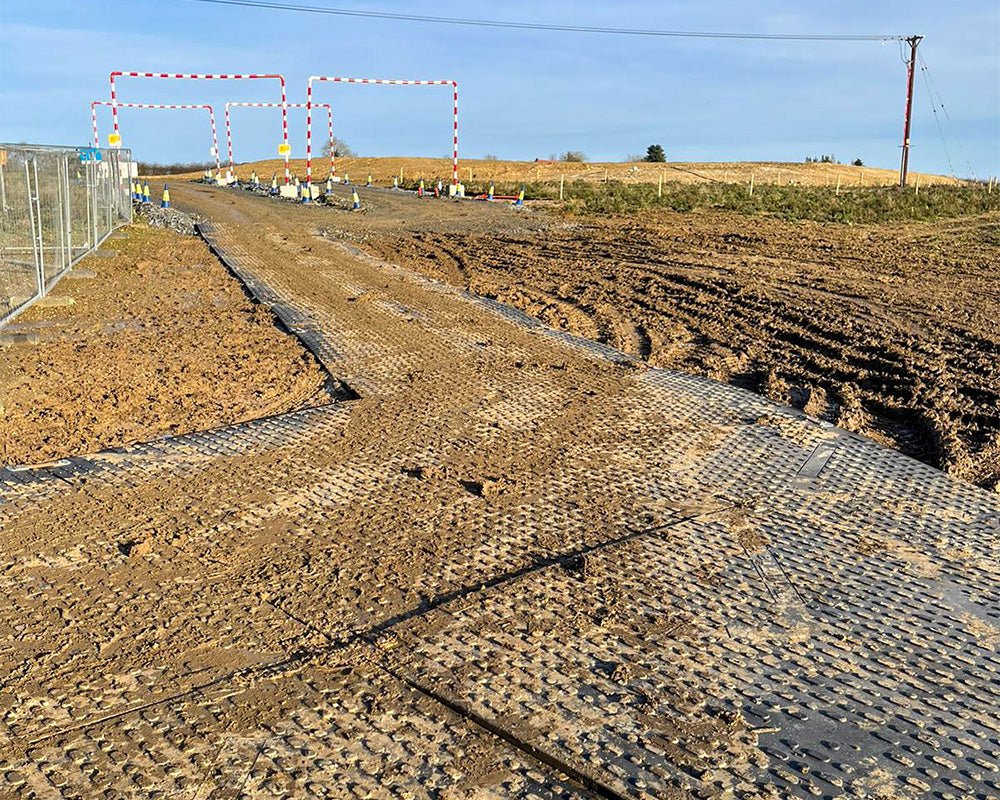
A road that works for pickups will not work for a heavy crane on a lowboy. Axle loads, turning paths, bridge ratings and frost heave all show up the first time an oversize load rolls down it. Heavy-haul access roads are the part of a plant site that has to be right before anything else can arrive.
We build them for refineries, fab shops, oilfield-services yards and new plant sites around Casper. The road might be a quarter mile of paved connector to a state highway, or several miles of gravel across rangeland to a well pad or a pipeline staging area. In both cases we start with the load, the route and the season, then design the section.
We pair this work with laydown yards and gate design so the haul route works from the highway all the way to the lift.
Loads, turns and clearances
Start with the design vehicle. A heavy-haul trailer with a multi-axle dolly needs a wider turn radius than a standard semi, and the inside of that turn takes more load than the outside. We draw swept paths for the largest vehicle on the haul permit, then widen the curve and the apron to match. Overhead lines, signs and guardrail ends are checked for clearance before the road is staked.
Loads drive the section. We estimate equivalent axle loads from the heaviest planned moves and the expected truck count over the life of the road. A temporary road for a three week turnaround is a different design from a permanent plant entrance. We say which one you are paying for. If the road crosses a drainage, we size the culvert and headwall for the load that will pass over it, not for the pickup in the survey photo.
Building the road, step by step
We clear and grub the alignment, strip topsoil, and proof-roll the subgrade, using the same clearing and grading methods we use on a plant pad. Soft ground gets undercut and replaced, or stabilized with geotextile, geogrid or cement depending on the soil. The base is placed and compacted in lifts and tested for density. Pavement goes on when the season allows. If the road stays gravel, we use a crushed section with enough fines to lock together and a crown that sheds water.
Drainage runs through everything. Roadside ditches, cross culverts and rock-lined outlets move water off the road and away from the shoulder, because a saturated shoulder is how a rig ends up on its side. Where the road meets a public highway we build the approach to the road authority's standards, with sight distance, turn lanes where required and an apron that keeps mud off the pavement. Signs, gates, cattle guards and speed controls close out the package.
Highways and fields around Casper
Casper is served by Interstate 25, US Routes 20, 26 and 87 and several state highways, and it is the supply point for the oil and gas country around it. The Salt Creek field in Natrona County had produced more oil than any other Rocky Mountain field by 1970 and now uses CO2 enhanced oil recovery. Operators at that scale keep a steady stream of heavy equipment on the roads, and they need field roads that drain and carry load across long distances. That traffic also matters to utility and pipeline owners who share the corridors.
Wyoming Highway 387 leaves I-25 at exit 227 and runs about six miles east to Midwest before continuing through Edgerton. Haul traffic on that corridor includes rigs, tubulars and process equipment, and the last mile from the highway to a pad or plant is usually owned by the operator. That last mile is where we work. Closer to town, US 20/26/87 leave I-25 at Beverly Street and carry heavy loads east toward the refinery district.
Pavement or gravel
Gravel is fine for low-volume field roads and for temporary access. It is fast, it can be regraded, and it costs less up front. It also needs maintenance and dust control, and it can rut in spring. Asphalt suits roads that see steady truck traffic and a plant entrance that gets a lot of attention. Concrete is the right choice at turning points, at gates and at scales, where tire shear and braking loads tear apart a flexible pavement.
We lay out the choice with the owner. Sometimes the answer is a paved apron at the highway, gravel through the field, and concrete pads at the gate. We build the road so it can be upgraded later, starting with a base that is sized for the final surface. That saves the cost of tearing out a thin road to build a thick one.
Working near moving iron
Haul roads have the worst mix of hazards: traffic, equipment, buried lines and weather. We run a traffic control plan, hold a safety orientation before work starts, and keep the work zone clearly marked. Where the road crosses a pipeline or cable corridor, we get line locations, pothole to confirm depth, and build a protected crossing with a cover design approved by the line owner.
Oversize moves have permits and escort requirements. We coordinate our schedule with the hauler so we are not building a road while a crane is trying to arrive. When the haul is live, construction stops, equipment is parked clear and the flaggers are in position. Then we reopen. That discipline is the difference between a clean shutdown start and a delayed one.
Seasons and mobilization
Frost leaves the ground slowly in spring, and spring thaw is when unsurfaced roads fail. We try to build the base in late summer and fall and pave when temperatures allow. When a shutdown schedule forces a winter build, we use frost-protection blankets, non-frost-susceptible fill and heated materials. The cost goes up, and we tell you by how much.
Work backward from the first oversize load. Add time for permits, clearing, utility locates and curing. Plan for a final inspection before the first heavy move, not after. We can phase the road so the first section is useable early while the rest is built behind it.
Where we build these roads
We build haul roads across Natrona County and the Casper metro, from the plant district near east Casper to field access near the Salt Creek oil field, and to the highway approaches that connect them. A road into a manufacturing plant gets the same treatment as one into a well pad. If your site is outside the metro, call anyway. We will tell you whether we are the right crew for it.
Send the route and the heaviest load
Give us the start, the destination, the heaviest planned move and the date. We will walk the route and come back with a road section, a price and a schedule.
Common Questions
How do I know what load the road must carry?
Ask the equipment vendor and the hauler for the gross vehicle weight and axle configuration of the heaviest move, then add the expected truck volume. We turn that into a pavement or gravel section. A geotechnical report on the subgrade completes the picture.
Gravel or paved for a field access road?
Gravel for low volume and short life, paved for steady truck traffic. A combined road is common: paved at the highway and gate, gravel in between. Dust control and maintenance should be in the budget either way.
Do you handle highway approach permits?
We prepare the approach design and coordinate with the road authority. The authority sets requirements for sight distance, turn lanes and drainage, and its review time belongs on the schedule.
Can you keep the road open during construction?
Often yes, with a phased plan, flaggers and a temporary detour. If the road is the only entrance to an operating plant, we schedule the work around shift changes and deliveries.
What if the road crosses a pipeline?
We locate and verify the line, get the owner's written crossing requirements and build the crossing to them. No heavy equipment crosses an unprotected line.