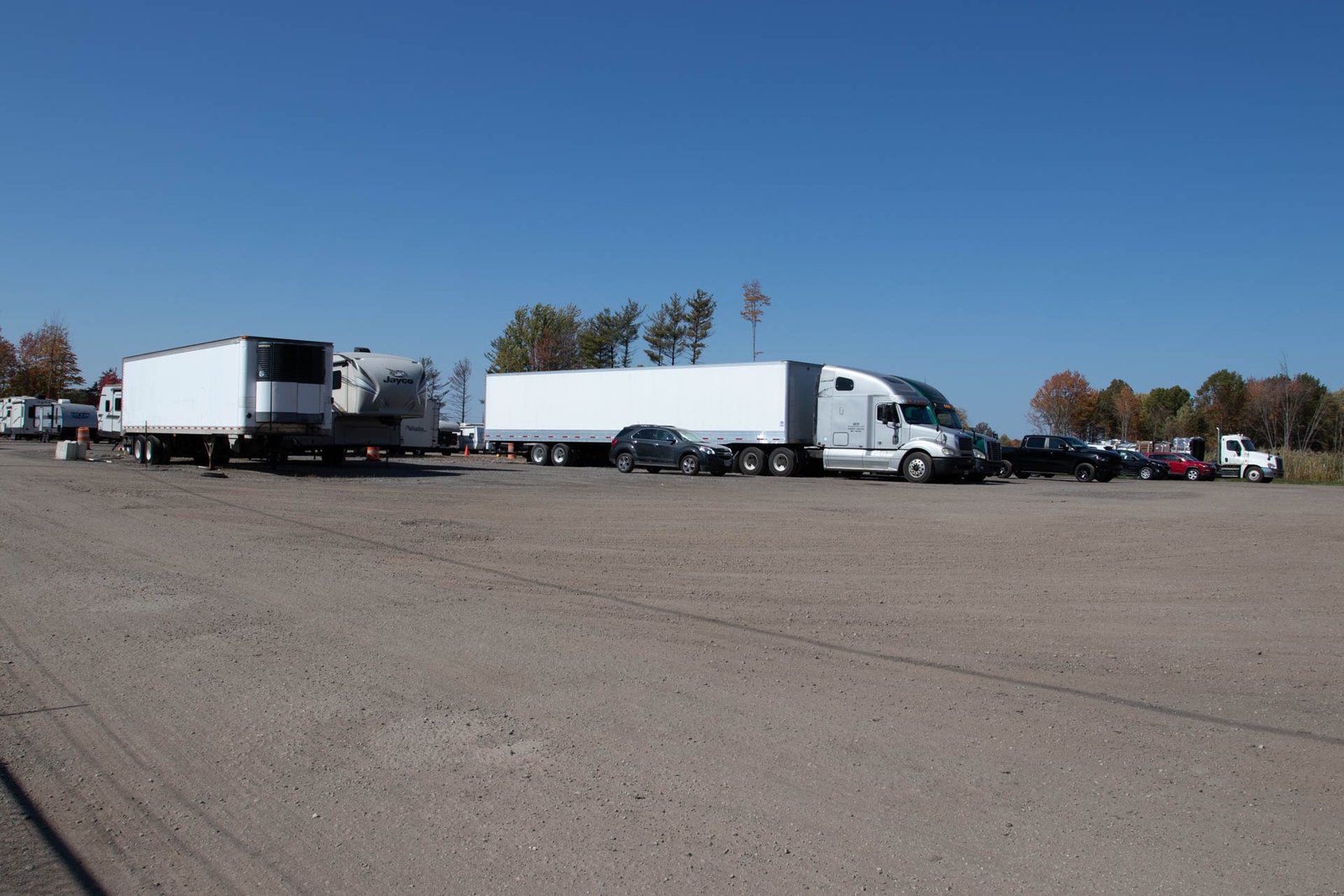
Landing gear on a loaded trailer puts a point load on the pavement that a car park never sees. A truck court and trailer yard has to carry that load, turn full-length trailers without clipping curbs, drain without ponding and survive freeze-thaw. We build truck courts and trailer yards for truck terminals and cross-docks, fab shops, supply yards and oilfield-services operations in Casper, in concrete or heavy asphalt as the loading and budget call for.
Pavement is the part of an industrial site that gets abused hardest and noticed last. Cracks start at the first winter. A yard that was graded and compacted well, drained well and paved with the right section lasts. A shortcut shows up in year two.
We design to the owner's traffic: how many trucks, how heavy, where they turn, where they park and where they wait. The layout comes before the thickness.
Know your traffic first
Start with the truck count, axle weights and turning paths. A yard for light delivery vans and one for loaded tankers or heavy haulers need different sections. Where trailers sit parked with landing gear down, concrete pads under the gear protect asphalt from punching. Where trucks turn tight, concrete holds up better than asphalt, which scuffs and ruts.
Think about growth as well. A court sized for ten trucks a day can be a bottleneck at twenty. We look at stacking room, queue length at the gate and how trucks enter and leave. Staging space on the property keeps trucks off the public road, and the court connects to the buildings through dock aprons and loading zones.
Highways, rail and the east side
Casper's industrial trucking follows its roads. Interstate 25 carries traffic north and south. US 20, 26 and 87 leave the interstate at Beverly Street and run east along Yellowstone Highway through Evansville, the corridor most east-side industrial sites use. North of town, I-25 has exits at Wardwell Road, Westwinds Road and Ormsby Road, each a gateway for yards that want highway access without crossing town.
Out near the airport, an 18-track rail yard 19,000 feet long handles bentonite, barite, refined products and oilfield and construction materials. A 2026 report put it at about 150 cars a month, down from about 500 in peak years. Trucks serving that kind of yard add heavy axle loads to nearby courts, and we design for them. The east Casper industrial area is where much of this work sits.
Subgrade, section and joints
Pavement lives or dies on its subgrade. We proof-roll, fix soft areas and place a compacted base with the thickness the design calls for. Concrete pavement gets dowelled joints, jointing patterns to control cracks and curing that protects it from drying wind and cold. Asphalt gets proper lift thickness, compaction and tack coat between layers.
Joint design matters in a freeze-thaw climate. Sealed joints keep water out, and unsealed ones let it in to freeze and break edges. We detail the edges where trailers turn, the dumpster pads, the fueling zones and the gate approach, where braking and turning forces are highest. The discipline is the same as for industrial concrete floors, with weather on top.
Where the code stops and the engineer starts
Commercial site plans in Casper typically go through Planning and Zoning and plan review, and the engineered site plan must show drainage, access and surfaces. The city lists a three-foot frost line and severe weathering for design. Pavement thickness is not set by the building code. Your civil or geotechnical engineer sets it from soils and traffic.
Fire access matters too. Fire apparatus need a clear route around buildings, and the truck court is often that route. We coordinate lane widths, turning radii and gate openings with the fire code official so the court serves both trucks and fire trucks.
Concrete or asphalt, and what it costs
Asphalt costs less up front, and concrete lasts longer under heavy turning loads. A common mix is asphalt for drive lanes and concrete pads at docks, gates, fueling and landing-gear zones. We price both and show life-cycle cost, not only the first price. Base thickness and subgrade repair often matter as much as the surface material.
Drainage, lighting, fencing and striping add up. Water control is often the largest hidden cost, covered under stormwater detention and drainage, and security gates follow in fencing and security integration. Yards that stage coils, plate and pipe for metals and heavy industry need the heaviest sections.
Keeping trucks and crews apart
A working yard has trucks, spotters, fuelers and drivers on foot. During construction we build the same separation into the plan: one-way routes, marked walkways, a spotter at every blind turn and a gate attendant checking drivers in. Delivery trucks get the site orientation at the gate before they back anywhere.
When we pave an operating yard, we phase it so the trucks always have a route in and out. Hot asphalt, curing concrete and saw cuts each need their own exclusion zone, and we post them in plain language. Nobody walks through a pour.
Design the yard around the trucks
Send the site plan and a rough truck count, axle weights and turning needs. We will lay out the court, recommend a pavement section and price the work. Call us or use the quote form.
Common Questions
Concrete or asphalt for a trailer yard?
Both work. Concrete handles tight turns, landing gear and fuel better and needs less upkeep, but costs more up front. Asphalt is cheaper and quicker, and it suits straight drive lanes. Many yards use concrete in high-stress zones and asphalt elsewhere. We price the options with a life-cycle comparison.
How thick should the pavement be?
It depends on the soils, the traffic count and the axle loads. Your civil or geotechnical engineer sets the section. We build it as designed, test the subgrade and base, and flag any soft area before the surface goes down. Skimping on thickness is the most common reason yards fail early.
How do you stop landing gear from punching through?
With concrete pads in the parking stalls, or a thick enough base and asphalt section if the stalls are asphalt. The pad spreads the point load over a larger area. We place pads where trailers will park and check that they drain, so water does not freeze under the gear.
Can you build the yard while trucks keep moving?
Yes, in phases. We close a section, build it, open it and move on, with temporary routes and traffic control. Concrete needs curing time before it takes load, so the phasing plan accounts for that. We agree with operations on the sequence before we start.
Where do the trucks queue?
On your property if the layout allows, which is why gate position and stacking length are part of the design. Queuing on the public road creates safety and permit problems. We lay out the gate, the check-in lane and the staging area so the first truck in the morning does not block the street.