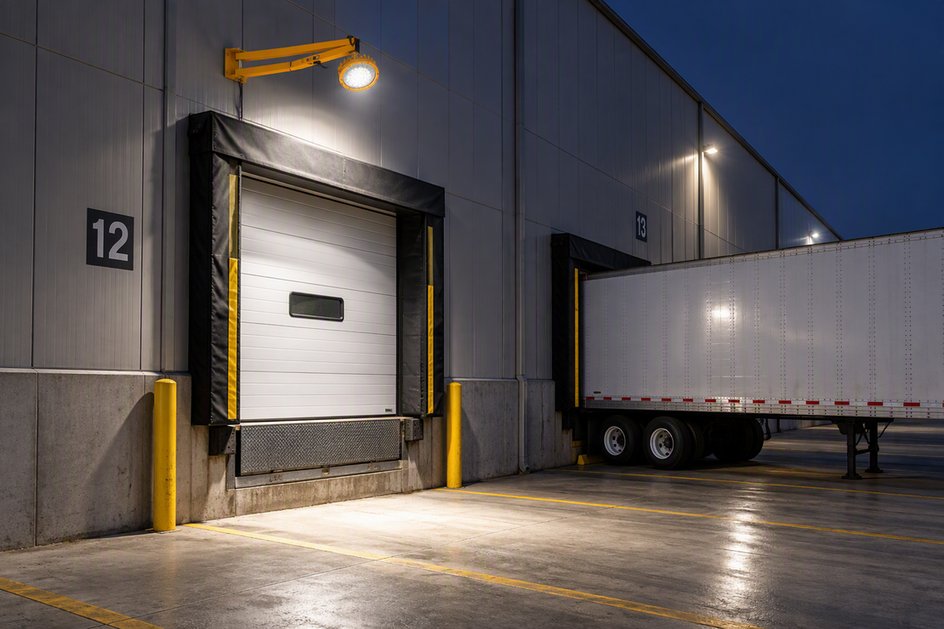
The apron in front of a dock door takes more abuse than the building behind it. Trailers back in, brake, drop landing gear, load and pull out, again and again, with forklifts crossing the same strip. Dock aprons and loading zones are the concrete, drainage, levelers, bumpers and striping that make that routine safe and long-lasting. We build them for warehouses, terminals, fab shops and supply buildings in Casper and the surrounding county.
The apron is where the building meets the yard, so it ties together the floor, the pavement and the drainage. Heights must match among dock floor, leveler and trailer bed. Slopes must carry water away from the door, not into it. Freeze-thaw breaks anything that holds water.
Whether you receive pipe, pallets, parts or pumps, the loading zone sets your throughput. A badly planned one slows every truck.
Buildings that need aprons
Cross-docks and truck terminals have the most doors per building, and a distribution center stages freight on one or both sides. A fab shop may have one or two docks and a drive-in door for large parts. A supply yard may have a covered loading canopy. Each pattern needs a different apron: a cross-dock needs long, wide pads, and a fab shop needs heavy pads under a crane lift zone.
Near the airport, more than 35 businesses sit in the business park, from manufacturing to aviation, and the foreign trade zone the airport operates covers nearly all of the county, with a 492-acre magnet site at the airport. Operators who move freight in and out of that zone need loading capacity that matches their volumes. The Casper logistics hub is a second magnet site, listed at 984 acres.
What a dock package includes
Dock apron slabs with dowelled joints and a depressed approach, levelers and pits, bumpers and wheel guides, seals or shelters, overhead doors, bollards, trailer restraints, drains and trench drains, striping, signage and lighting. Drive-in doors and ramps for forklifts and pickup trucks are included where a building has them.
Pits and levelers are poured integral with the slab and need exact elevations from the building floor. We coordinate with the building contractor and equipment supplier and survey the pits before the pour. The apron connects to the yard through the truck court, and its drains connect to stormwater detention and drainage.
Pour it once, pour it right
Aprons are placed with attention to grade: a slight slope away from the building, a flat zone where trailers sit and a depressed approach so the trailer bed meets the dock. Surveyed forms, dowels across joints and reinforcement at pits control cracking. Gear loads and forklift wheel loads are checked against slab thickness.
Curing in cold wind is the weakness in this climate. We cover, heat and cure concrete so it reaches strength and resists scaling, and we use air-entrained concrete in the exposed apron. Joints are sealed once the concrete is dry, with a backer rod and a sealant that stays flexible in a wide temperature swing. Deicing salts and trailer drip damage the surface, so we avoid shortcuts on the mix.
Questions for the operator
How many trailers per hour at peak? What mix: vans, flatbeds, tankers or rail-served freight? Do you need doors that take two dock heights? Where do forklifts cross? A good dock plan considers the trailer fleet today and in five years.
Water control, lighting and security complete the zone. Lights at the door help evening and winter loading. Gates and fencing control access, covered under fencing and security integration. Cold storage operators ask for tight seals and vestibules, and our refrigerated dock retrofits handle those upgrades on existing buildings.
Ordering and pouring
Dock equipment is long-lead. Levelers, doors and seals often take weeks, and the pit dimensions come from the equipment drawing, so the order goes out before the pit is formed. We track the submittal, the delivery date and the pour date together.
Pours depend on weather. Cold and wind affect the finish and cure. Aprons often pour near the end of the building schedule, when the yard is stable, and that may fall in the first cold snap. The city lists severe weathering for the area, so we set a cutoff date after which we wait for spring or add protection.
Dock hazards we design out
Dock work has its own hazards: trailer creep, forklift crossings, falls at open edges and pinch points at levelers. We specify restraints, wheel chocks, bollards, edge guards, lighting and clear sightlines. We also plan the construction phase: closing doors during pours, protecting workers from backing trucks and posting traffic control.
When we work at an operating dock, we close one door at a time, keep forklift traffic away from the work and follow the owner's permit to work. Nobody stands behind a backing trailer without a spotter. After handover, we leave a one-page dock safety layout for your supervisors: where chocks go, where forklifts cross and who calls the stop when a trailer moves early.
Plan the doors and the apron together
Send the building plan, the door count and the trailers you serve. We will check the apron layout, the pit details and the drainage, and price the loading zone. Call us or use the quote form.
Common Questions
How wide should a dock apron be?
It depends on the longest trailer you serve and the turning space in the yard. Common practice gives a trailer length plus room for the tractor to maneuver, and the truck court plan confirms it. We check the swept path before we pour, because widening a slab later is costly.
Can you retrofit levelers into an existing dock?
Yes, but it takes cutting the slab, forming a new pit and matching the existing floor. We survey elevations first, schedule the work around operations and protect cargo and staff from dust. It is usually done one door at a time to keep the building working.
How do you keep water and ice off the apron?
By grading the apron away from the doors, placing trench drains where water collects and keeping the joints sealed. Roof drainage is routed so it does not run across the approach. In winter, we recommend a snow storage plan so melt does not refreeze on the pad.
What concrete mix do you use for aprons?
Air-entrained concrete with a strength and thickness suited to wheel loads and freeze-thaw. The engineer specifies it, and we place and cure it for cold conditions. Hard-troweled or broom finishes are chosen for traction and wear.
Can the apron be built while the building operates?
Often, one section at a time. We close part of the apron, build it and open it again, with temporary dock access. Concrete needs curing time before trucks use it, so the phasing plan includes that wait. We agree on the order with your operations team.