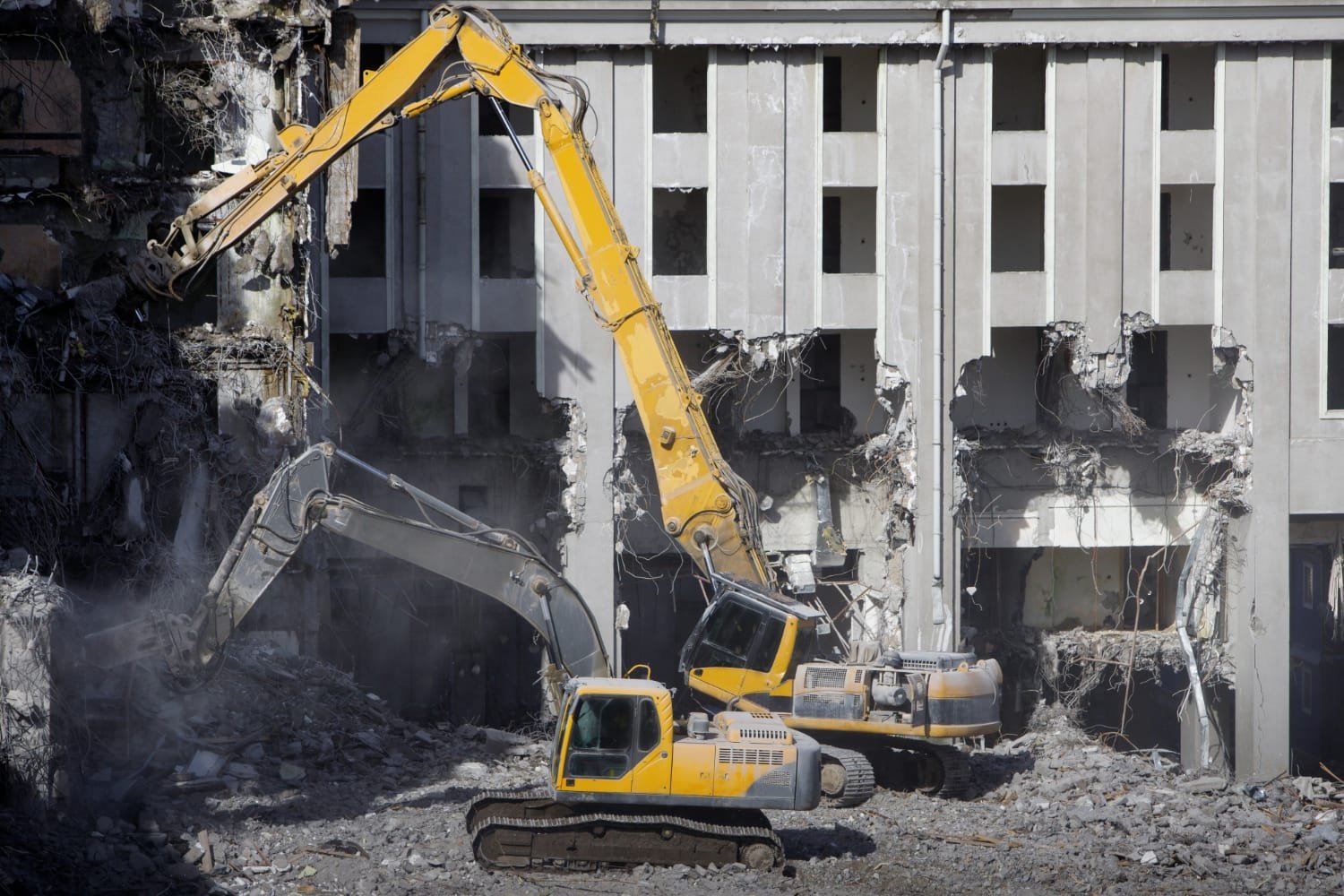
Before anything comes down, everything has to be turned off. Power, gas, steam, water, process lines and stored energy are all isolated, tagged and proved dead before a machine touches a wall. Industrial demolition is mostly planning, and the planning is mostly safety. We take down industrial buildings, tanks, structures and equipment in Casper and Natrona County with a permit to work for every step.
The scope ranges from selective strip-out of a bay for a retrofit to total removal of a plant. We handle interior demolition, steel cutting, concrete breaking, foundation removal, tank dismantling, utility cut and cap, hauling, scrap recovery and site restoration. Each job starts with the question: what is in this building that could hurt someone?
Owners usually want the site ready for what comes next, whether a new building, a laydown yard or a sale. We plan demolition and the follow-on work together, with site clearing and grading picking up where the wreckers leave off.
Isolation, hazards and the permit to work
Industrial buildings hold surprises: residual product in lines, asbestos-containing materials, lead paint, PCBs in old transformers, silica in masonry, fuel in tanks, sumps and pits. Before we mobilize we review the owner's records, order the surveys the law and common sense require and write a plan. Confined space entry, hot work, excavation and lockout/tagout each carry their own permits.
The crew goes through your orientation. Exclusion zones keep people clear of falling debris, equipment swing and cutting torches. Fire watches follow every cut. Dust is controlled with water. Structures that may be unstable get an engineer's review before anyone is under them. We stop the job whenever conditions change, and we write down why. A wall that was sound on Monday can be wet, frozen or loaded with snow on Thursday, and the foreman has the authority to change the plan without asking.
What comes down in this country
The Casper area has a long industrial history. A refinery operated on what is now Platte River Commons from 1895 to 1991, and the site was later reorganized as a reuse area, with the former tank farm becoming a business center. A small restaurant and motel at Hell's Half Acre closed in 2005 and were later demolished. The Dave Johnston Power Plant at Glenrock is a large coal-fired generating station. Buildings of that scale, and the sites around them, change over time.
Closer to town, the refinery in east Casper replaced units built in 1928, 1948 and 1955 in a two-year modernization, and old equipment had to come out as new went in. Selective removal inside operating plants is routine work in this market, and it is usually done in a shutdown window with a short list of dated tasks and a day-by-day plan for where every piece goes. Our Platte River Commons and Glenrock pages describe the places where this history sits.
Selective, interior and total demolition
Selective demolition removes part of a building, such as a wall, floor, bay or roof section, while the rest keeps operating. It demands precision: shoring, protection of adjacent systems, controlled cuts and clean dust barriers. Interior strip-out removes finishes, equipment and utilities to prepare a space for renovation. Total demolition takes the structure to grade and often the foundations too.
Specialty items include tank dismantling, stack removal, crane runway removal, equipment rigging and pit and sump closure. Steel is cut, sorted and sold as scrap where possible, and concrete is crushed for fill when the material qualifies. When a slab is the target, we often pair with demolition and slab replacement.
Permits, notifications and disposal
Demolition has its own permit trail. The City of Casper lists the 2024 International Codes with Title 15 amendments, and commercial permits often call for engineered drawings and Planning and Zoning review. Demolition permits, utility disconnect confirmations and, where asbestos is found, state notification and licensed abatement all have to be in place before work starts.
Wyoming leaves building code enforcement to qualifying cities and counties, so the local building department is the starting point. Material disposal needs the right landfill and the right paperwork. Hazardous or regulated waste goes through licensed haulers and manifests, and we keep every record. We cannot promise a landfill's acceptance without testing, so we ask for sample results early.
What drives the demolition price
Hazardous material abatement is the largest swing. A building with no asbestos or lead is far cheaper than one that needs licensed removal. Next is access: a building in a tight yard, beside live equipment, takes longer than a building in an open field. Then there is the haul distance, since Wyoming distances are long and landfills may be far from the site.
Scrap steel and recycled concrete can offset costs, and we show the credit as a line item. Scrap prices move, so we state the price basis and the date, and we do not bury a scrap credit in the lump sum. Foundations, pits and underground tanks are the unknowns, so we carry allowances and report what we find. Before making a budget, owners can compare against the cost of leaving the building and securing it, which is sometimes the cheaper short-term answer.
What follows demolition
Once the structure is gone, the site needs work. Fill, grading and drainage come first, then utilities, then whatever is next. Owners often move straight to phased construction on the adjacent live site or to a new building. In utilities and power and metals and heavy industry, demolition is routinely part of a modernization.
The same demolition partners handle the jobs in a manufacturing plant that require removing equipment foundations and old slabs before the new line arrives. Plan the demolition and the new construction together, and you save mobilizations, trucking and float. Removing an old foundation after the new one is poured is the kind of surprise we try to eliminate in the first site walk.
Tell us what is in the building
Send the building records, any surveys and the target date. We will walk the site with your safety lead, flag the permits and surveys needed and price the demolition with a hazard plan and a disposal plan.
Common Questions
How do you decide between selective and total demolition?
It depends on what you want to keep and whether the structure is sound. Selective work costs more per square foot because it demands protection and precision. Total demolition is faster but needs a plan for foundations and disposal.
What surveys do we need first?
An asbestos and lead survey at a minimum, plus an environmental review for tanks, pits and soil. Older plants may have PCBs or residual product. We help scope surveys and read the results.
Do we need a permit?
Normally yes. Demolition permits, utility disconnections and abatement notifications are required, and the local building department sets the rules. We handle the paperwork with the owner.
Can you demolish part of an operating plant?
Yes, with isolation, barriers and a permit to work. We schedule noisy or risky work in shutdown windows and keep the operating side protected.
What happens to the scrap and debris?
Steel is sorted and sold as scrap, and concrete may be crushed for fill if clean. Regulated waste goes to licensed disposal with manifests. We give you the paperwork.