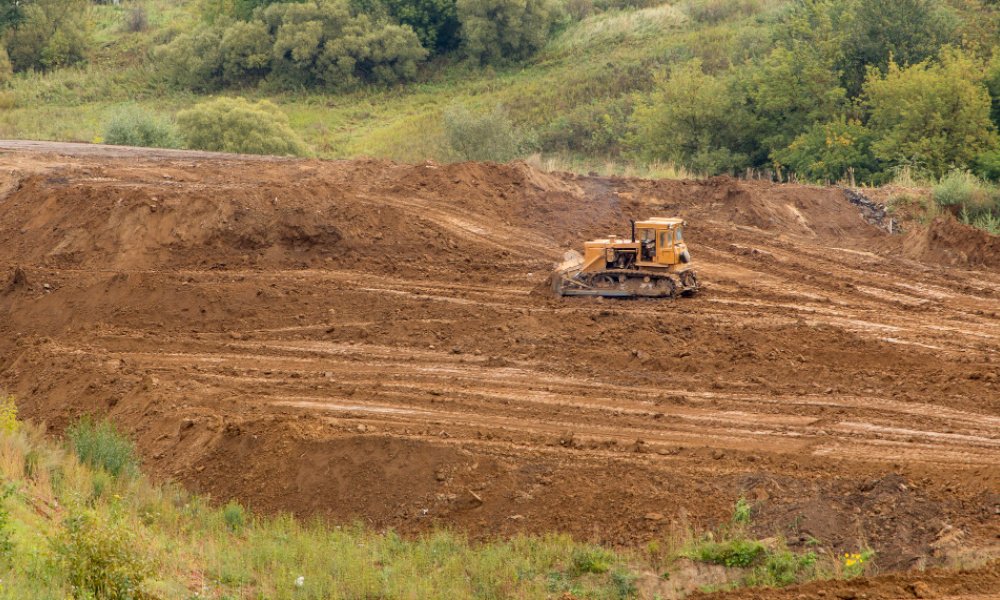
Dirt moves in Casper only while it is thawed, dry enough to compact and clear of snow. That window is shorter than most schedules assume. Site clearing and mass grading is the first real work on a plant or yard, and everything after it, utilities, foundations and pavement, depends on getting the subgrade right. We clear, strip, cut, fill and compact industrial sites to the grades the civil drawings call for, and we test as we go.
Our clients are owners and developers of yards, plants, trucking sites and oilfield-services facilities. They want a flat, drained, stable pad that will carry heavy loads without settling and will not turn to mud in March.
Grading is cheap compared with fixing it later. A foot of bad fill under a slab or a truck court costs more to repair than the grading package cost to build.
What the grading package includes
Clearing, topsoil stripping and stockpiling, erosion and sediment controls, rough and fine grading, cut-to-fill balancing, structural fill placement and compaction, subgrade proof-rolling and temporary haul roads. We also remove old foundations, buried debris and abandoned utilities found on previously used ground.
Grading ties into drainage from the start. Slopes, swales, ponds and outlets are shaped as we cut, which is why stormwater detention and drainage is planned with the earthwork. The next step on many sites is a stabilized surface, covered under stabilized laydown yards.
The ground we work in
Casper sits on the North Platte River at 5,150 feet. The 984-acre Casper logistics hub at 6 Mile Road and Commerce Street and the roughly 250-acre rail yard northeast of the airport show how much open ground the metro has for industrial use. Open does not mean easy. Soils near the river behave differently from the benches, groundwater can sit shallow near the water, and previously developed parcels carry fill from past use.
Wind is constant. It dries the ground fast and blows dust. We water for dust control, which neighbors and plant operators notice, and we check wind speed before large cuts or loose stockpiles are left open.
Working the frost window
We start earthwork as soon as the ground thaws and dries, and we finish subgrade work before the freeze. Frozen ground cannot be compacted to spec, and frozen fill can settle later when it thaws. If a project must work in winter, we protect the subgrade, use insulation or heaters, and remove frozen material before placing fill.
A common plan is to strip and rough grade in the fall, leave stable temporary drainage over the winter and finish the pad in spring. We talk through the trade-off with owners. Fall work saves spring time but risks a wet pad if winter is wet. The city lists severe weathering and a three-foot frost line for the area, and both shape these choices.
Balance the site and prove the pad
We aim for a balanced site, where cut equals fill, so trucks stay on the property and haul costs stay down. Survey and machine control let us hit grades without over-excavating. Topsoil is stripped and saved for landscaping or sale. Structural fill is placed in lifts and tested for density by a third-party tester.
Before paving or concrete, we proof-roll the subgrade with loaded equipment and repair soft spots. We hand you density reports and a final survey. If the geotechnical engineer finds trouble, undercutting and replacing is faster than hoping, and we do it right away. The next trade is usually the site utilities package.
Heavy iron, tight rules
Earthmoving puts the heaviest machines in the smallest space. We run a traffic plan with spotters and one-way routes, require backup alarms, set exclusion zones for walking crews and hold daily equipment inspections. Operators and drivers get the site orientation before they enter. Dust control and noise are part of the plan.
Before digging, we locate every utility. The state one-call system is the first step, but in older industrial ground it is not enough. Pipelines, abandoned lines and unmarked conduits can sit under a yard. We pot-hole and hand-dig near known lines. Inside an operating plant, excavation permits apply and the owner's team signs off before the bucket touches dirt.
What moves grading cost
Volume and distance move the number: how many yards of cut, how many of fill and how far the trucks haul. Soil type matters, as does moisture. Rock or cemented layers slow production. Import fill and export spoil are costly if the site is not balanced. Winter work adds heat, frost removal and slower production.
Large industrial sites also carry cost for erosion control, dust control, haul road upkeep and testing. We separate those lines so you can see them. Operators in logistics and distribution often phase grading with the pad, starting with the truck court and then the warehouse building footprint.
Get the pad ready before the freeze
Send the parcel, the grading plan if you have one and the date you need a pad. We will walk the site, check the soils data and give you a sequence that fits the frost window. Call us or use the quote form.
Common Questions
When can earthwork start in the spring?
When the ground has thawed through the depth we are working and has dried enough to compact. That varies by year and by site, so we check with test pits and the geotechnical engineer, not the calendar. Starting too early produces fill that fails density tests and has to be redone.
Can you grade in winter?
In limited cases. We can strip topsoil, work on dry frozen ground for rough cuts and keep haul roads open. Structural fill and final subgrade should wait for thaw unless the budget supports heat and insulation. We will tell you what is possible and what it costs.
How do you handle dust?
Water trucks, limited exposed area, stabilized haul roads and wind checks. Wind in Casper is a regular condition, so dust control is built into the plan and the price. Sensitive neighbors, rail operations and plant air intakes are identified before work starts.
What do I get to prove the pad is good?
Density test results by lift, proof-roll records, survey as-builts and the geotechnical engineer's sign-off where required. These reports go in the turnover package and support the foundation and paving warranties that follow.
How do you control runoff while the site is open?
Perimeter sediment controls go in before the first cut, and we keep them repaired after every melt or storm. Stockpiles are shaped and covered, and temporary swales send water to a sediment trap instead of the street. Bare slopes are stabilized as soon as grades are final. Larger disturbed areas usually need construction stormwater permit coverage, and we confirm the thresholds for your site early.
What if we find contamination or old tanks?
We stop, protect the area and notify you and the environmental consultant. Handling and disposal follow the regulations and the consultant's direction. Because the Casper area has an industrial past, we plan for this possibility on previously developed parcels.