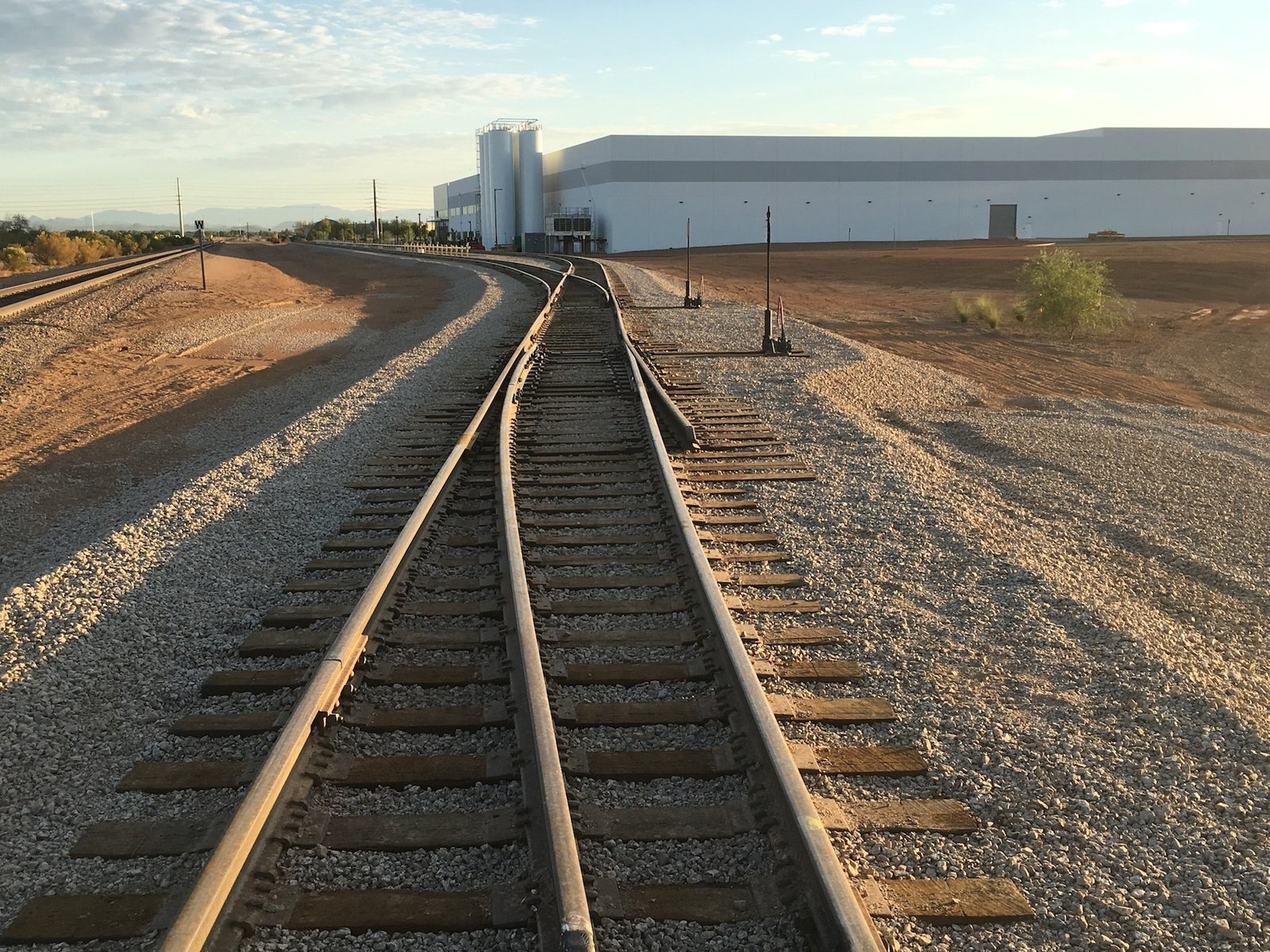
Northeast of the Casper airport, eighteen tracks and 19,000 feet of yard sit on about 250 acres, and the cars on them carry bentonite, barite, refining products, fertilizer, wind-energy components and construction materials. That is the rail picture around Casper. It is also the reason a plant owner with a spur needs to think about ground, drainage and containment as much as the track itself.
We do the site work around rail: grading and subgrade for the track, drainage along it, loading and unloading pads, truck access to the transload point, containment where product is handled, and the yard around it. The railroad or its track contractor sets the rail, ties and turnouts. We build what the track sits on and everything that serves it.
Rail work is slow to approve and fast to go wrong. Our job is to get the site ready so the track crew does not wait on us.
The site work around a spur
The subgrade is the foundation of the track. We strip the surface, undercut soft or organic material and replace it with compacted structural fill, usually capped with a layer of subballast before the track contractor places ballast and ties. Grade is set to the railroad's centerline and profile. A spur that settles loses its alignment, and a derailment starts with bad alignment.
Beside the track we build a loading pad or a truck apron. Concrete is common where a loader or a dumper repeatedly works the same spot, and where rail cars unload to trucks or hoppers. Drainage runs away from the track, because water under ties kills a subgrade. We also build containment and spill control where product is transferred, with sumps and berms sized to the material, and we coordinate those details with the owner's environmental lead.
Rail around Casper and the logistics hub
A rail line terminates at Casper, and the short-line yard on the northeast side was developed around 2012. Its traffic has varied. Peak years saw about 500 cars a month, and an August 2026 report puts the current figure near 150. That swing is why an owner thinks twice before building a spur. It also means there is spare yard capacity nearby for companies that want to ship by rail without owning track.
The Casper Logistics Hub is listed as a 984 acre Magnet Site of Foreign Trade Zone 157 at 6 Mile Road and Commerce Street. A site like that can host a spur, a transload pad or a cross-dock with truck and rail access on the same parcel. Operators looking at logistics and distribution use a similar model: a short spur, a lot of room, and a trucking connection that reaches the interstate.
Working beside live track
Live rail has its own rules. Before we step near an active track, we get the serving railroad's right-of-entry requirements, complete the contractor safety orientation it requires, and arrange flagging when the work is within the railroad's clearance envelope. We do not cross, park equipment on or stack material near an active track without written clearance. Equipment operators and spotters are briefed on that line every morning.
Inside the plant fence, we separate trucks from rail operations. Gates, bollards, wheel stops and clear signs keep drivers out of the car-spotting area. Where a switch engine will move cars past a work zone, we agree on blue flag procedures and lock-out of the track. Work gets planned around the permit to work, with the railroad movement schedule posted so nobody is guessing.
Agreements, approvals and who signs off
A spur connects to the railroad's track under an industry track agreement. The railroad sets the standards for the turnout, the track geometry, the clearances and the materials, and it reviews the plans before construction. Our grading and drainage drawings follow those standards. We do not guess at clearances or grades, and we do not start dirt work before the railroad confirms the alignment.
The local side is separate. A new spur, loading pad or transload yard in Casper goes through the city's commercial permit process, which can require engineered site plans and Planning and Zoning approval, and an issued permit is good for 180 days. Outside the city, the county or town process applies. We prepare the site package so both reviews can run in parallel instead of one after the other.
Work that ties into the track
Rail is one half of a freight yard. The other half is trucks, so we also build truck courts and trailer yards and the paved aprons that feed the transload pad. Heavy slabs for unloading and storage fall under industrial concrete floors, and where cars drop product into a building, a cross-dock layout keeps the flow simple.
If the yard doubles as staging for turnaround freight, we design it alongside a stabilized laydown yard so loaded-out equipment has somewhere stable to sit. One coordinator uses the survey and control points to keep the pieces lined up.
What a spur actually costs
The track itself is often the smaller line. The railroad's engineering, flagging and inspection fees add up, and so do the turnout and any grade crossing. On the site side, subgrade depth, fill import and drainage are the big items. A site with soft ground, a high water table or rock under the surface can double the earthwork cost.
Volume matters. A spur that sees a few cars a week may cost more than it saves compared with trucking from the yard northeast of the airport. A spur that handles unit trains or regular carloads of heavy product pays back. We will price the spur and the trucking alternative side by side so the decision is made on numbers, not habit.
Bring the car count and the site plan
Tell us the product, the volume per week and where the track meets your property. We will review the ground and give you a site package and a schedule that fits the railroad's process.
Common Questions
Do you build the track too?
The railroad or its approved track contractor builds the rail, ties and turnout, and we do the site work around it: subgrade, drainage, pads, access and yard. We coordinate dates with the track crew so the ground is ready when they arrive.
Is a private spur worth it in Casper?
It depends on volume. Car counts on the local yard have run from about 500 a month at the peak to about 150 more recently, which shows how much the traffic can swing. If you ship regular carloads of heavy product, a spur can pay back. If not, a transload pad near the yard may be cheaper.
How long does railroad approval take?
Plan on months, not weeks. The railroad reviews the plan, issues the agreement and schedules flagging. We start the civil design while approvals run so dirt work can begin the day the railroad releases us.
What about spill containment at the transload?
We build sumps, berms and impermeable surfaces sized to the product. The environmental requirements come from the owner and the product's safety data sheet, and we follow them.
Can work happen near an active track?
Only with the railroad's written clearance and flagging as required. We plan work windows around the car-spotting schedule.