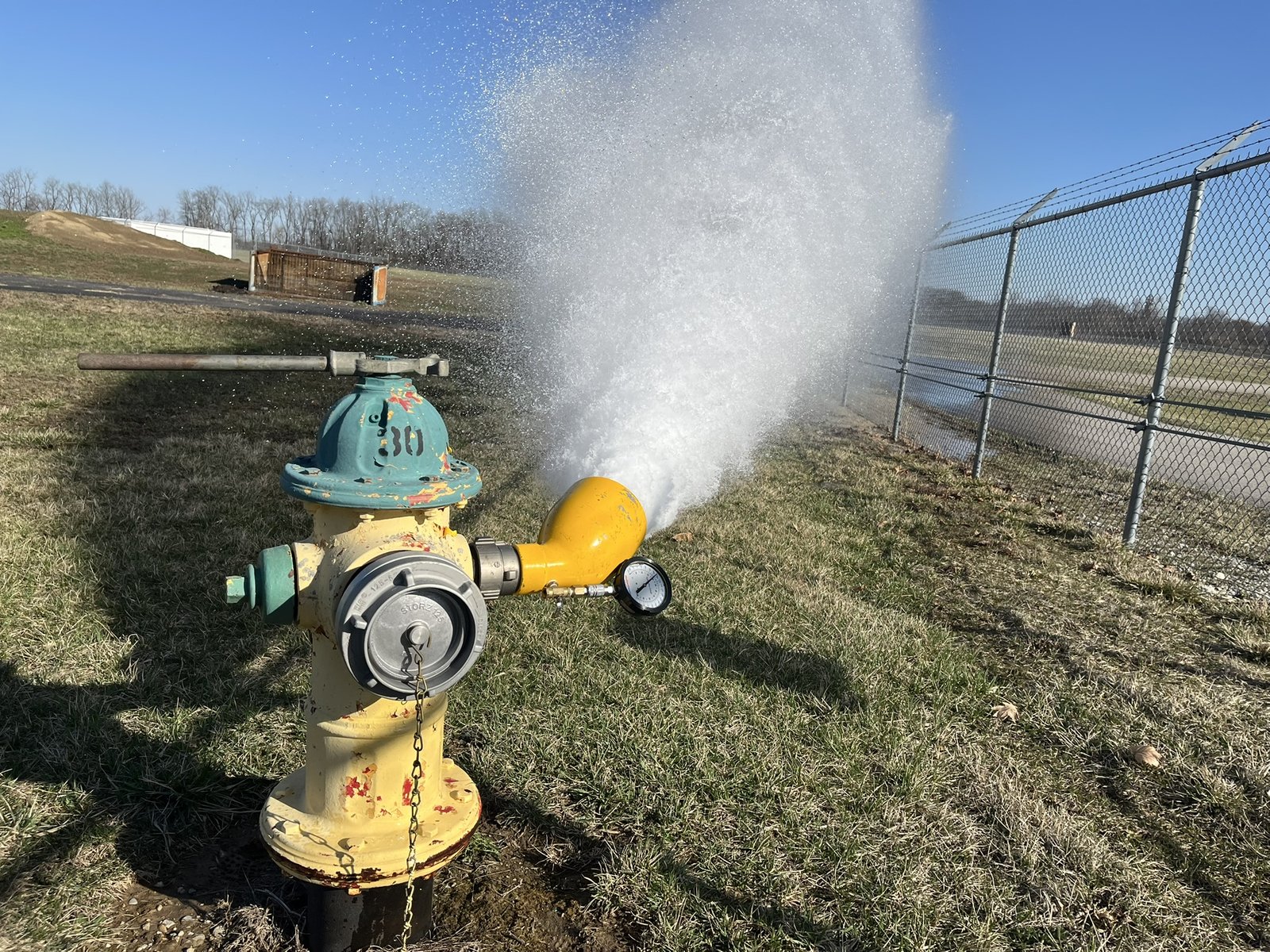
Fire water that freezes is not fire water. In Casper, where the city lists a three-foot frost line, severe weathering and a 3,000 air freezing index, the loop that feeds hydrants, sprinkler risers and monitor nozzles has to be buried, drained or heated correctly, and tested while the weather lets us. We build fire water loops and hydrant systems for plants, yards and warehouses where the loss of a building would stop the business.
A loop is a ring of buried pipe around the facility, fed from two directions where the supply allows, so one break does not isolate a hydrant. Sectional valves let us shut off a piece and keep the rest live. Add hydrants, post indicator valves, fire department connections, and a fire pump or tank if the city main cannot meet the demand.
Process plants add foam, deluge and monitor systems. Warehouses add large sprinkler demands. Either way, the flow number sets the pipe size, and the pipe size sets the cost.
Digging beside hydrocarbons and live water
Digging beside a refinery fence or an oilfield-services yard means hydrocarbons in the soil and live lines in the ground. We gas-test trenches, keep ignition sources out and follow the owner's excavation and hot work permits. A fire watch is posted for any welding or cutting.
Impairments are the other safety issue. Every time a fire line is shut down for a tie-in, the facility is less protected. We plan the shutdown with the owner, post notices, provide temporary protection where needed and restore as fast as possible. Hydrant and valve work follows the same rule as any life-safety work: no surprises and no unlabeled shutoffs.
Fire code and plan review
The state adopted the 2024 International Fire Code, and administrative rule 041-1 incorporates it with Appendices D through G. The City of Casper lists the 2024 International Codes, and commercial permits there often call for a life-safety plan and engineered site drawings. Fire flow, hydrant spacing and apparatus access are set with the fire code official, so we meet that office before design is fixed.
A hydrant flow test tells us what the city main can supply, and the result decides whether you need a pump or tank. Underground fire service pipe is flushed and pressure-tested, and the tests are witnessed. We schedule those with the inspector and keep the paperwork for your insurer.
What the system includes
Underground fire main and loop piping, sectional valves with indicator posts, hydrants with breakaway flanges, thrust blocks or restrained joints, fire department connections, building service entries, valve vaults, a fire pump house or tank, and the power and controls to run the pump. We add traffic-rated covers and bollards at hydrants.
The loop connects to our site utilities package and must be coordinated with paving and parking, because pipe under pavement is hard to fix. Hydrant positions are tied to truck courts and to the route the fire department's apparatus will use.
Building the loop in the right order
Pipe first, then thrust restraint, then testing, then backfill and paving. Fire main goes in with proper bedding below the frost line and is restrained at bends, tees and hydrants, because pressure surges push against fittings. We set valves and hydrants to the elevations of the final grade, not the rough grade, so paving does not bury or strand them.
We flush the line before connecting to buildings, pressure-test at the required level and keep the records. The pump and controller are factory-tested, then acceptance-tested in the field with the inspector. Before turnover we tag every valve and hydrant and give your team a map of the loop. That work feeds directly into commissioning and turnover.
What sets the price
Demand sets pipe size, pump size and tank size. Large warehouse sprinkler demands, or foam and deluge at a process area, can double the system. Loop length, depth and the number of valves and hydrants drive pipe cost. Rock and groundwater add excavation cost. E-commerce fulfillment buildings with racked storage are among the largest sprinkler demands we see.
Owners often ask about insurance. Insurers weigh water supply, hydrant coverage and impairment practices, and a better system can affect premiums. We do not promise discounts, but we can build to the insurer's guide if you ask. A site near the Evansville refinery, rated at 30,000 barrels a day, has protection needs well beyond a warehouse. A logistics fulfillment center and a process unit need different water, and the budget shows it.
Timing around the freeze
Underground fire work is sequenced right after utilities and before paving, with hydrant tests set in the weather window. Pipe tests need water, and water in cold weather means risk, so we avoid leaving charged lines exposed. If the schedule forces winter testing, we heat, insulate and drain.
Fire pumps and tanks are long-lead items. A pump house with a diesel pump needs fuel and heat, and an electric pump needs dedicated power and often a generator. Those orders go out early, as described under long-lead procurement management. Plan on the fire official visiting before occupancy, so the loop has to be ready first.
Get the fire water right before the paving goes down
Send the site plan, the building use and any flow test data. We will work out the loop, valves, hydrants and pump needs with your fire protection engineer and price the package. Call us or use the quote form.
Common Questions
How do I know what flow my site needs?
The fire protection engineer calculates it from the building use, storage height, sprinkler design and hydrant needs, and the fire code official confirms it. A hydrant flow test on the nearest main shows what the city can supply. If the demand exceeds the supply, a pump, a tank or both close the gap.
Do I need a fire pump?
If the city main cannot deliver the required flow and pressure, yes. Tall racked storage and process areas often need one. A pump adds a pump house, power, a controller and testing, so we raise the question in preconstruction, before the building layout locks.
Can you test in winter?
Yes, with care. We heat, cover and drain lines, and avoid leaving charged piping exposed. If a test must be delayed to avoid freeze damage, we say so and agree on an interim plan with the inspector. A good schedule avoids it by finishing the loop in warm months.
Who owns the hydrants on my property?
Hydrants on private property are generally the owner's to maintain. Hydrants on public streets belong to the water provider. We mark ownership on the as-builts and tell you which tests and maintenance routines apply, so there is no confusion in an emergency.
What happens to fire protection during a tie-in?
The affected section is out of service for the shutdown. We plan a short window, notify the owner and fire official, provide temporary protection where needed and test on restoration. Hot work stops during the impairment unless the owner's permit says otherwise.